
_edi.png)
Render Unto Caesar: Why Christian Nationalism Misses the Point
"Then render to Caesar the things that are Caesar's, and to God the things that are God's." — Mark 12:17
Few passages in all of scripture have been stretched, twisted, and repurposed as aggressively as this one. Conservative politicians quote it to argue against taxation. Progressive ones quote it to argue for it. It has been wielded as a weapon by virtually every political movement that has ever sought to claim Christ as its mascot. And in doing so, they have all missed the point entirely.
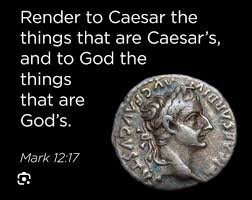
Because this verse is not about taxes. It is not about the size of government, the role of the state, or any earthly political arrangement whatsoever. It is about something far more profound: the fundamental separation between the Kingdom of God and the kingdoms of man.
When Jesus spoke these words, he wasn't endorsing Rome. He wasn't undermining it either. He was simply drawing a line. Caesar's world is Caesar's world. God's Kingdom is something else altogether — something higher, something eternal, something that no flag, no constitution, and no political party can ever contain or represent.
This distinction matters enormously in our current moment.
We live in a time when a growing movement within Christianity — Christian Nationalism — is actively working to blur that line. At its core, Christian Nationalism holds that America should be governed as a Christian nation, with laws, institutions, and power structures designed to enforce and preserve Christian dominance in public life. It is a movement built on the pursuit of supremacy.
But supremacy was never what Jesus was about.
Consider how he lived. He walked among the poor, the sick, the outcast, and the marginalized. He did not establish a political party. He did not seek control of the Roman Senate. He did not lobby for legislation. He healed people. He fed people. He sat with people that polite society had thrown away. His revolution was entirely one of the heart — and it changed the world more profoundly than any empire ever has.
The Founders of this nation, whatever their individual faiths, built something remarkable: a country where no single religion could claim the machinery of government for itself. That was not an accident. It was a deliberate safeguard born from the lived experience of religious persecution. America was intended to be a place where a Catholic and a Baptist and a Jew and a Muslim and an atheist could all live as equal citizens under the law. That vision is worth protecting — including by Christians.
None of this means we abandon our calling as believers. We are absolutely called to let our faith shape our lives, our communities, and our culture. We are called to pray that others will come to know the love of Christ. We are called to be salt and light in a broken world.
But salt does not conquer. Light does not coerce. And Christ did not command us to legislate his Kingdom into existence. He commanded us to love.
Here is perhaps the greatest irony of Christian Nationalism: in its hunger to make Christianity powerful, it actually makes faith weaker. When a religion requires the force of law to sustain itself, it has already confessed that it cannot sustain itself on its own merits. The Gospel does not need a government behind it. The Word of God does not require a Congressional majority to be true. Our faith is not legitimized by whoever sits in the Oval Office — and it is not threatened by them either.
What belongs to Caesar, let Caesar have. The coin bears his image — let him keep it. But we bear the image of something far greater. And no empire, no nation, no political movement has ever been worthy of that.
Our witness is not our votes. It is our lives.


Comments